Wednesday, August 26, 2009

Just Say No

I realized tonight that I've become a drugaphobe--not in the recreational sense (though I'm certainly phobic of those) but in the pharmaceutical sense. I am leery of anything stronger than Ibuprofen or Tylenol or, if absolutely necessary, an occasional antibiotic. Even these I take far less frequently than I used to: only when the throbbing headache or incapacitating sinus infection renders me useless to the world and I'm left no option but to pop a few pills.

I never used to be this way. I used to happily ingest medication, prescription and over-the-counter alike, without a second thought. No concerns about side effects. No worries about how they might be affecting my organs. No care about the drug's process in my finely-tuned body.

This new facet of my personality developed, I realized, when I learned that my body was actually capable of conceiving, growing, and delivering a breathing, thinking, feeling, fully-functioning person. It changed the way I perceive my body--for the better, mostly. But it has also made me starkly aware of the way medicine interacts with the systems. And while I'm 99.99999999999999 percent confident that I am not currently incubating a tiny human, the very, very, very small chance that it's within the realm of possibility is enough to make me eschew all things pharmacological.

Unfortunately, I'm supposed to be taking three medications right now because there's a good chance I have H. Pylori, a bacterial infection of the stomach that may be the cause of some of the weird but intense abdominal pain I've been having off and on lately. This, or I have a hiatal hernia, which was in all likelihood induced by pregnancy (lovely: more ailments, fear of drugs, all thanks to the wonders of maternity). So my doctor prescribed this strong course of treatment that comes in bottles with warning labels that say things like, "DON'T EVEN THINK ABOUT GOING OUTSIDE IN THE SUN WHILE TAKING THIS MEDICATION" or "A GLASS OF WINE MAY KILL YOU WHILE ON THIS MEDICATION" or "DO NOT EVEN TOUCH THIS BOTTLE IF YOU ARE PREGNANT, MAY BECOME PREGNANT, OR ARE NURSING."

Okay, the warnings aren't quite that strong, but they are in all capital letters with little drawings for the folks who can't read the giant doomsday text. And I'm thinking, why do I want to put these things in my body if we don't know for sure what's going on? Oh, that's right: because if I do have the infection, my chances of getting stomach cancer increase, and that's a disease that, sadly, runs in the family.

So I took my three pills tonight, lamenting and kvetching the whole time. My husband laughed at me and my irrational attitude toward controlled substances prescribed by a highly-educated, duly-informed professional who's taken an oath to "First, do no harm." And he's right. This doctor knows way more than I do, no matter how proficient my googling skills are. I need to relax, trust the guy with the medical degree, and hope that this treatment relieves me of these awful pains.

But I'd like to state for the record that I'm not happy about it. I will gladly resume my medicine-free existence in ten days. Hopefully, I will also resume a pain-free existence in ten days--the jury's still out on that one. In the meantime, I will be carefully scheduling my three-times-a-day doses to be sure I don't take them less than an hour before eating (especially dairy) or less than two hours after eating or within a half hour of lying down (you can thank the medicine for this post for that very reason).

I'm going to give myself an ulcer just thinking about it.

Monday, August 24, 2009

The End of Summer

I'm a little giddy in my soul from this morning, high from the rush of love and exuberance I shared with Ben during our end-of-summer celebration. These moments when I get him all to myself are so rare, so precious. I can listen fully, watch completely, absorb every detail of his person and world without distraction--no eyes darting to make sure his sister isn't about to careen headfirst into something hard or sharp, no interruptions, no refereeing.

Just being. Together.

We squeezed every second of fun out of our morning together at the near-empty, carnival-esque park. We bounded from ride to ride with utter abandon. We didn't have to bother with lines, with long boring speeches about keeping our hands and legs inside the vehicles, with the disappointment that a ride was coming to an end. If Ben wanted to ride again, we rode again, smiling and laughing until our cheeks ached. I think we tried every ride a four year old is permitted to enjoy. It was two hours of unhurried, unfettered, unabashed delight.

Now he is sleeping soundly in his room, his body worn from the sensory rush. And I am savoring the moments in my mind, sipping the warmth of them slowly, deliberately. He heads back to school Wednesday, off to master more of his world in the insatiable way he has when it comes to learning. Our days will fall back into the comforting routines of fall, and Abby and I will fill our mornings with our own adventures. It is all good.

But the time shared today will remain seared in my heart as a reminder of all that is wondrous about the relationship with a child, about the new eyes we receive when we enter into the world with them, through them. I need to open them more, these eyes, from places other than the kitchen or car or store. The world is a thrilling place when I look, when I break the grown-up inertia of to-do's to share the view with my darlings.

Sunday, August 23, 2009

Joining the Conversation

Abby has begun to understand the nuance of language: idioms, exclamations, intonation. My favorite right now is "Holy Moly!" As in:

"Ho-wee Mo-wee! Iss haht ouh-sighd!" or
"Ho-wee Mo-wee! I'm uh mehss."

This morning, Josh asked her what she wanted for breakfast, and she stood there in her pajamas in the kitchen, reflecting on the options and saying thoughtfully, "Ahmmmm..." before declaring with certainty in her signature volume, "Tohst!"

It's hysterical to watch the evolution. I mean, she's always had a voice. Even as an infant she had something to coo about everything, but now she's wielding it with authority, with panache, with gusto.

So this morning, when she returned empty-handed from her trip upstairs which she took expressly for the purpose of retrieving her water cup, naturally we asked her where her cup was. She stood there looking at us with one foot cocked out to the side and replied simply, matter-of-factly, with all the confidence and poise of Barack Obama, "Up-tairs!"

Causing Josh and I to fall into uncontrollable giggles.

Friday, August 21, 2009

"This Is Your Hand"


I found this poem last night and felt it captures perfectly the tenuous balance I try to strike with the kids: teaching them about the world, little by little, knowing with every explanation or definition, there is a universe of thought and meaning that cannot yet be spoken. But it will be someday.

I found this poem as I was searching for poems that could be read at a funeral. Big Abby's mommy passed away Monday. "Big Abby" is our babysitter, and Ben coined that title to distinguish her from our own little Abby. I met her in my life before children when I taught English at a local high school. She was in one of my freshman classes, and I grew to know her more through her involvement with student Senate and through her roles in the theater department. Last year, I wrote her a letter of recommendation for the well-respected theater program at her university, and she is to begin this new endeavor next week. She called me yesterday to ask if I had any recommendations of poems she could read at the funeral. "How do you find a poem for a funeral?" she asked. "Google funeral poems? That seems morbid." So I spent the evening looking for poems in my anthologies from college.

Her mother had fought cancer for 15 years, but her death was unexpected, related to a fall she took on their family vacation a few weeks ago (which I'm sure was related to the cancer). I imagine there must be some confusion to lose someone who seemed always on the brink of leaving to something other than the constant, epic battle. Whatever the case, this beautiful, 19 year old girl will now walk out into the world without a mother to bring her flowers on opening night, to meet the man who will be her husband, to hold her children as they grow. My sadness for the totality of her loss is indescribable.

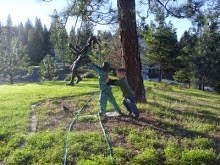
I see little Abby's hand in the picture--so concrete, so sure, learning the world through all that is tangible and literal. Now, she sees a yellow flower, feels its soft, delicate existence, hears the bumblebees flitting nearby. Someday, she will see more: beauty? hope? the love of her mother who captured the moment? It is a strangely, beautifully, tragically complicated life we live.

You Begin
by Margaret Atwood

You begin this way:
this is your hand,
this is your eye,
that is a fish, blue and flat
on the paper, almost
the shape of an eye.
This is your mouth, this is an O
or a moon, whichever
you like. This is yellow.

Outside the window
is the rain, green
because it is summer, and beyond that
the trees and then the world,
which is round and has only
the colors of these nine crayons.

This is the world, which is fuller
and more difficult to learn than I have said.
You are right to smudge it that way
with the red and then
the orange: the world burns.

Once you have learned these words
you will learn that there are more
words than you can ever learn.
The word hand floats above your hand
like a small cloud over a lake.
The word hand anchors
your hand to this table,
your hand is a warm stone
I hold between two words.

This is your hand, these are my hands, this is the world,
which is round but not flat and has more colors
than we can see.

It begins, it has an end,
this is what you will
come back to, this is your hand.

Thursday, August 20, 2009

Cortical Remodeling and the Power of Forgiveness

A few nights ago, I joined my sister at a seminar conducted by Dr. Timothy Vollmer, a leading neurologist at the forefront of MS (multiple sclerosis) research. He spoke about how new science and research are reframing the discussion about the disease's course in individuals as researchers better understand when and where the actual damage occurs in the brain and when and how symptoms show up as a result.

Whereas scientists used to believe there were three distinct phases of the disease that occurred throughout a patient's life, each marked by respectively more and more disease activity in the nervous system leading to greater and greater symptoms or disability, they're now learning that the disease really does most of its damage early on. What's interesting is that early on, when the disease damages nerve fibers, the brain is able to "rewire" itself through different neural pathways, thereby compensating for the loss of damaged nerves (a phenomenon known as "cortical remodeling" or "cortical remapping"). So it's actually possible, or likely, for the disease to be at work in someone before there are noticeable symptoms because the symptoms are masked by these compensatory activities of the brain. Eventually, however, the brain loses its ability to reroute its signals as easily and therefore can no longer compensate for the damage; this is when new or permanent symptoms arise.

It's actually very much like the process that occurs during aging. From birth, we all lose brain cells and neural pathways to the extent that we don't use them (which is why we're encouraged to expose babies and children to other languages, to music, etc., so that these neural pathways remain intact). At some point through the years, our brains lose their plasticity, their nimbleness, their ability to form new pathways, and this is when we begin to see deterioration in eyesight, hearing, mobility, memory function, etc. The brain literally shrinks with the loss of neural pathways as we age, or in the case of MS, with the nerve damage caused by the body's inflammatory immune response. In fact, the size of the brain of a patient in the first stage of MS (the relapsing-remitting phase) is akin to that of a healthy sixty year old.

Fortunately, as with aging, the best defense against MS is a good offense: use the brain as much as possible, both cognitively and physically, in order to maintain its optimal ability to rewire.

Now, all of this is fascinating in and of itself, but as I was spinning this morning on the patio of the rec center, looking at the endless rows of mountains, listening to the entire American Idiot album by Green Day (the instructor was in a Green Day mood), soaking up every ray of sunshine, I had this thought: what if our "hearts" actually function like our brains?

I mean, I've grown more and more convinced lately that people act out of their pain. People are hurt, wounded by someone else in their life, sometimes horribly and deeply, sometimes less obviously, and so they lose a little of themselves. They harden this part of their heart and then rewire their behavior to compensate for this loss. They learn to protect themselves through meanness or performance or humor or victimization or perfectionism or abrasiveness or avoidance. And so they become, in some ways, defined by their hurt.

Recently, I was talking with a friend in the throws of making a significant life decision, and all she could think about was how it would affect her parents; the whole discussion was framed not by whether the decision was right for her life and her goals and her values but by whether it would anger her parents too much. The irony was, the decision she wanted to make was actually the one her parents would want her to make, but she couldn't even evaluate her own thoughts because the voice of her parents was so strong in her head.

I think this is why I struggle so much with the idea of a bad guy, because I know that every villain has walked his own painful journey through life, and who knows the experiences that may have shaped an innocent child once upon a time? This is also the source of so much of my anxiety about my children: worry that they will run into one of these deeply wounded people one day; worry that they will be inadvertently wounded by me or someone else and compensate in destructive ways.

But I also think that this is where the power of forgiveness comes in.

I try to apologize to Ben when I have treated him impatiently or unfairly because of my own tiredness or stress or worry, and when I do, I ask him to forgive me. And he always asks, "How do we forgive?" That's a difficult question to answer--one I haven't understood very well to this point--but as I've thought about it more these last few months, I'm beginning to think that forgiveness involves letting go of the hurt that we've endured so that it doesn't damage our heart, so that we don't lose or close off that part of ourselves, so that we don't nurture a trespass and wake up one day to find we've become a different person to compensate for the loss.

As I watch Ben interact with his world, I find myself holding my breath when he encounters meanness or selfishness or aggression or manipulation, praying that he will not let those encounters or experiences change him. I understand now that what I'm really hoping for is his ability to forgive those people--to let go of that pain--so that it doesn't take root in his heart and shape who he becomes.

I also think that this may be what God was able to accomplish through Christ: to take on every hurt, every shame, every trespass, every cruel or ugly or false thing that people do to themselves and others and yet forgive it all, let it all go, so that He is not defined by fear nor by anger nor by pain--except that now He understands our struggle for he's walked much more than the proverbial mile in our shoes.

Instead of hardening His heart or seeking revenge or exacting penance, He offers peace with God and gives us the grace to forgive those around us so that we will no longer be defined by our hurts, so that we will no longer act out of our pain, so that we can be free from the way others have defined us and instead stand in the truth of who He has created us to be. The places where our heart was once hardened become the places where God's mercy and grace are most brilliantly displayed to the hurting world around us.

So I sat there pedaling, listening to Green Day, marveling at the power of forgiveness to prevent our hearts from dying little by little and having to rewire themselves like our brains. Then I realized, as with aging and MS, the best defense is probably a good offense: to exercise our hearts as much as possible.

And I think that's called love.

Monday, August 17, 2009

My One-Volume Wonder

"There are lives I can imagine without children but none of them have the same laughter and noise."--Brian Andreas

I found this quote when I was looking at greeting cards in one of our local gift stores this weekend, and I loved it so much, I bought the card to hang on the wall near my desk.

It's true: there are lives I could imagine without children, and these imaginings usually arise when I'm feeling especially tired or frustrated or tied down, when I'm wishing Josh and I could run away for a weekend or, let's be honest, just an evening without having to handle the logistics of sitters and kids' schedules and the very weighty responsibility that comes with children. Or when my list of to-do's grows longer and longer by the day, but the impossibility of tackling any of the items while the kids are awake stares back at me every time I look at it. So I stare at it during nap time or when the kids have gone to bed for the night, but by that time, I barely have the energy to stare at the walls, let alone clean out my files.

And then there's the noise--oh, the noise! Lately, Abby has become the one-volume wonder: loud. Whether she's happy or frustrated, excited or heartbroken, she communicates every thought and emotion at the top of her lungs. While it's adorable when we're petting a basset hound on the street and she says, "I wahn uh peh duh dah-ee agaihn, peeeeez!" it is less charming when we're finishing lunch at a restaurant and she says, "I wahn ouh, peez!" over and over so that every patron in the establishment knows her high-chair escaping agenda; most of the time, she barely pauses long enough to hear us say, "Abby, we'll get out as soon as we've paid!" And it's downright exhausting when we're at home and she announces without ceasing, "I wahn mihl, peez," the entire time we're getting her cup and pouring her milk and screwing the lid on for her. Somehow, early on, she grew to associate waiting patiently with using her manners, so even when I say, "Abby, I'm getting your milk right now. Can you please wait patiently?" she simply responds at a decibel level audible to our neighbors, "Peeeeeeeez!" (At least she does use her manners consistently--you can hardly chastise a not-yet-two-year-old for being too loud when she's clearly attempting to be polite). I think volume control is a concept that just simply does not exist for her yet.

On several occasions, I've told Josh that my greatest luxury is driving somewhere alone, either listening to my music or catching up on world events courtesy of NPR or, sometimes, enjoying the sweet sound of nothing--free from any responsibility to respond to someone's question, comment, observation, accomplishment, tears, or request.

But then there's the giggles--oh, the heart-warming, perspective-providing, soul-grounding effect of their laughter. It is a balm more effective than any spa treatment or Ibuprofen could aspire to. When Ben and Abby get that look, and one of them starts, and then the other joins, and they spend minutes upon minutes looking at each other and then doing something silly, and then falling over themselves and each other in the pure, unbridled joy of their delight, the sweet sounds of their laughter filling every corner of our home, I am smitten with this idea of family--at once swept up in the levity of their childishness while being drawn into that grown-up place of introspection that recognizes the beautiful, undeserved gift that is being a parent.

So I bought this card to hang over my desk as a reminder of these things.

The challenges are real, and hard. The chaos--even in my carefully orchestrated world of routine--is supreme. The noise, without doubt, threatens my delicate handle on patience, even while it comforts and amuses me in its innocence. There, indeed, are other lives that would be easier, neater, safer--and quieter.

But the laughter is glorious.

Sunday, August 16, 2009

Responsibility (and What I Really Want to Do)

Shortly, after the kids have woken from their naps and the clock approaches four, we'll load the pumpkins into the car and commence our forty minute drive to downtown Denver so we can help in the nursery at church.

What I really long to do--yearn for, even--is drive to church, give the kiddos a kiss, wish them a good time in Sunday school, hand them over to someone else, and then slide into one of the pews in the back of the sanctuary and let the music and the Truth of the evening wash over me as I sit in still, quiet, passive reflection.

For some reason, our summer weekends have been busy, full of travel and events and parties and all manner of good things with an occasional sickness thrown in for good measure, resulting in an inability to attend church with any kind of regularity. In fact, of the handful of times we've been able to go, only once have we been able to simply attend the service. The rest of the time, it has been either our turn in the nursery or it's been a home church Sunday (the last Sunday of the month, our church doesn't meet in a centralized location but rather meets in several homes throughout the Denver metro area). I love meeting as a home church, but thanks to the busyness of other people's summer schedules, our regular childcare for these home church meetings has been sparse, so for the last three months, even at home church I've been helping with the kids and unable to participate in the service.

I miss it. Tremendously.

Not because I think that missing church makes me any less spiritual or committed or devout, and not because I think attending church makes me any more spiritual or committed or devout, and certainly not because I think that loving these precious kiddos is unimportant, but because on a soul level, I hunger for Truth. And while I get tastes and glimpses of it everyday, everywhere--in music I hear, in interactions I see, in conversations I have, in movies and t.v. shows I watch, in books I read, in the grandeur of the mountains I behold daily--when I sit in The Sanctuary and hear Peter recast the Bible stories I grew up with in the Truth of God's mercy and grace, transforming hellfire and brimstone judgement into the consuming fire of God's love, I am set free. I can breathe more deeply. I can see more clearly.

I can walk away from the tree of the knowledge of good and evil, rejecting the temptation to judge myself and others in my attempt to make myself like God, and instead bow humbly, gratefully, and amazed at the tree where God's judgement is revealed--the cross. Where the only body broken and the only blood shed is His own, in love. Where the only words spoken over humanity are, "Forgive them, Father, for they know not what they do."

The old, misinformed paradigm from which I used to operate is chipped away little by little so that a little more of the the unique story God is telling through me, and each of us, is revealed. I am reminded of--and transformed by--gospel, good news.

But tonight, though I am tired and longing to hear this story in the sanctuary, I will go to the nursery and allow God to tell me His story in the more subtle ways. Not out of martyrdom, but out of my sense of responsibility to and gratitude for the other people who sacrifice their time other nights to care for my children. And hopefully next week, the stars will align so that we can drop off our children, slip into a pew in the back, and listen to the really good story God is telling through someone else.
Blog Widget by LinkWithin